The software engineering market is splitting in two: here's how to land on the right side

The tech job market in June 2026 is doing two things at once that shouldn’t go together. Companies are cutting engineers at the fastest pace since 2023, and at the same time, the biggest tech players are spending more than ever to hire a different kind of engineer.
Tech workers have absorbed nearly 150,000 job eliminations across hundreds of layoff events in 2026, a pace of roughly 974 losses per day, running 44% above last year’s already elevated rate. Meanwhile, the four largest hyperscalers, amazon, microsoft, alphabet, and meta, have committed to a combined $700 billion in capital expenditure for 2026, nearly double what they spent in 2025.
That’s not a crash. It’s a sort. And understanding which pile you’re being sorted into is the first step to moving yourself to the other one.
What’s actually happening
The market isn’t shrinking, it’s getting pickier. Indeed, the hiring lab’s tracking shows tech postings are flat, candidate supply per posting is up, and experience bars on open roles have tightened. The layoffs are real, but they’re concentrated at the top of the industry, hitting roles that used to feel secure. Oracle’s workforce reduction, estimated at 20,000 to 30,000 employees, represents roughly 18% of its global headcount, while meta’s roughly 8,000-person layoff, about 10% of its workforce, came the same quarter the company reported $56.3 billion in revenue, up 33% year over year. Meanwhile, the bureau of labor statistics still projects software developer jobs to grow 15% through 2032.
Demand didn’t disappear. It moved.
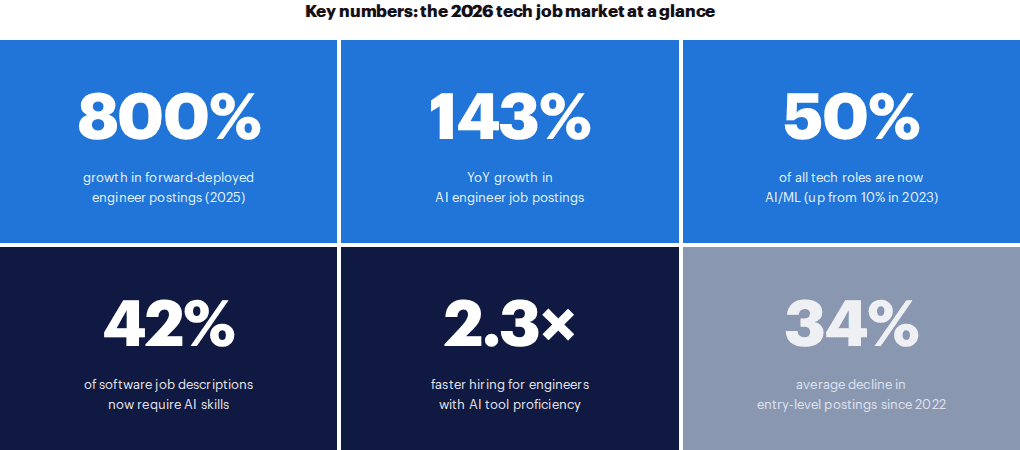
Where it moved is the real story. Linkedin’s 2026 jobs on the rise report ranked AI engineer as the number one fastest-growing job title in the US, with postings up 143% year over year, and four of linkedin’s top five fastest-growing roles are AI-related. The share of AI/ML jobs in tech went from 10% to 50% between 2023 and 2025, and AI skills now appear in 42% of software job descriptions, up from 8% in 2022. One role to watch closely: forward-deployed engineer postings grew over 800% in 2025, driven by enterprise buyers who refuse to deploy generative AI without a vendor engineer embedded directly in their stack.
On the language side, things are stable. The most in-demand programming languages in the US right now, based on 2026 job posting demand, are python, java, sql, go, and javascript. Typescript became the number one most-used language on github by contributor count for the first time in 2025, surpassing both python and javascript. But here’s the catch: python’s ubiquity means high supply, so it’s no longer a differentiator on its own. What differentiates candidates now is the AI-adjacent layer on top, things like pytorch, langchain, retrieval-augmented generation, and MLops fundamentals. ML ops skills such as model versioning, monitoring, cost optimization, and governance are now treated as minimum requirements rather than differentiators for AI-related jobs.
Language | Why demand is strong | Common role types | Best fit |
Python | AI, automation, backend services, data engineering | AI engineer, backend developer, data engineer | You want broad optionality across software and data |
Java | Enterprise systems, regulated industries, large platforms | Backend engineer, data platform engineer, enterprise developer | You want stable enterprise demand |
SQL | Data access, reporting, analytics, operational databases | Data analyst, DBA, BI developer, data engineer | You work anywhere near data |
Go | Cloud-native services, APIs, infrastructure tooling | Platform engineer, SRE, backend engineer | You want modern cloud and systems work |
JavaScript | Web apps, product teams, full-stack delivery | Front-end developer, full-stack engineer, product engineer | You want to build customer-facing applications |
Entry-level hiring is where the picture gets harder
Entry-level postings are down roughly 28% to 40% from 2022 peaks and have not recovered, even as the supply of cs graduates keeps growing. The junior share of new it hires has dropped from approximately 15% to 7% over the past three years, and stanford hai’s 2026 AI index found employment for software developers ages 22 to 25 fell nearly 20% since 2024, while developers 30 and older at the same companies saw headcount grow over that period. The encouraging note: things don’t appear to be getting worse, and precision hiring is starting to stabilize.
What this means for engineers right now
The bar moved, and a lot of candidates are still applying to the old one.
“Can you code” is table stakes now. Developers who add AI tool proficiency and system design expertise to their skills are securing roles 2.3 times faster than those who don’t. That gap represents real opportunity for engineers willing to close it.
Candidates also aren’t competing on volume anymore. The market is rewarding depth, AI-fluency, and demonstrated ability to deliver, and it’s increasingly passing over generalists.
For early-career engineers, this is the most important reframe: companies are being selective now because they can be, after years of stretching, to hit hiring targets in 2022.
The playbook: what to do about it
Build the AI-adjacent layer this month. Rather than vaguely “learning AI,” get specific. The most premium AI skills tied to the agentic wave are langchain, rag, multi-agent orchestration, and vector databases, and these are the exact skills employers are listing for the fastest-growing roles on the market.
Rewrite your resume around outcomes, not tasks. Every bullet point should follow the situation, action, and measurable result. If your resume still leads with “ML engineer” and your bullets describe feature engineering or hyperparameter tuning, you’re being algorithmically deprioritized against candidates whose recent work describes production agent evaluation.
Pick a lane and go deep. AI/ML engineering, cloud architecture, and security engineering roles are growing, while all other software roles face flat or declining demand. Choose one and become genuinely strong in it.
Target where the demand actually is. AI engineer roles concentrate in San Francisco, New York, and Dallas, with strongest sector demand from finance, healthcare, and cloud. And apply under the right title: roughly 70% of qualified candidates apply for AI roles under the wrong title and get filtered before a human reads their resume.
Stop relying on the apply button. Many job offers never reach job boards because they’re filled through referrals, and a candidate active in professional communities has access to this hidden job market. Build in public, seek out warm introductions, and if you’re early in your career, look closely at the forward-deployed or customer-facing engineer path, it’s growing 800% and remains less saturated than the standard junior developer search.
The takeaway
The market in June 2026 is brutal if you’re playing by 2021 rules, and genuinely winnable if you play by these. It’s a snapshot, and it moves fast, so don’t sit on it. Pick one move from the playbook above and start this week.